East Village at Deer Valley

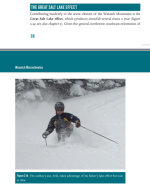
The lake effect—a meteorological phenomenon wherein cold air passes over a warmer lake—causes profoundly heavy snowfall along the Wasatch Range, precisely where the majority of ski resorts are situated.

Potentially for not all that much longer though: Great Salt Lake Drying Up/Overuse

Similar to when the great lakes freeze over in winter, once the fetch gets too small the lake effect will be over pretty quickly.
 
seems to imply that it's far more than what Steenburgh believes
Sorry, I trust Steenburgh way more than PeakRankings or the NY Times on the subject of Utah snow. As MarzNC notes above, he wrote the book on it, which I have and recommend highly.

Here's an interview with him with the lead question on the subject of the shrinking Great Salt Lake.
What is the true impact of The Great Salt Lake when you’re talking about mountain weather in your zone of the Wasatch?
Steenburgh: In the Cottonwoods, it’s about an average of about 5% of the cool season precipitation, so from October through April. We’ve done studies that vary from year to year: it can be as much as 10 or 12%. And it can be as little as almost zero. It depends on the patterns in any given year.
Steenburgh also visited Tug Hill in 2013 to study lake effect.

FYI when I was in SLC skiing over Memorial weekend 1985 the local concern was about flooding. The Great Salt Lake reached 4,212 feet in 1987 after 3 huge winters (Alta Collins 679, 619 and 694 inches) from 1982-1984 and resulting soil saturation. The Great Salt Lake is currently at 4,188 feet. But the current articles are correct. The issue is not drier weather but steeply increasing water consumption by development and agriculture.
 
Last edited:
Sorry, I trust Steenburgh way more than PeakRankings or the NY Times on the subject of Utah snow. As MarzNC notes above, he wrote the book on it, which I have and recommend highly.

Yes, I liked the analysis of the overall state of Utah, but I would disagree with their assertion that the Wasatch is overwhelmingly influenced by the Lake Effect of the relatively small Great Salt Lake.

I was not aware of Steenberg's book, but I read about 1/4 of it free online.


I really like the chart below for explaining Wasatch Snowfall. It is LCC's topography, not the lake effect—specifically, the uplift and the ability to receive snow from any storm direction.

(For example, Telluride is blocked chiefly from South-Southwest flow storms due to being on the backside of the San Juans in that type of storm. However, a relatively minor 2-6" storm coming into the canyon from the West-Northwest can easily dump 12-18".)

1761226147703.png
1761226191861.png


1761226916116.png


In short, Mayflower is located in a low snowfall, low elevation, and poor aspect area (maybe 100" per year, warm and faces early sun). Likely one of the worst Western resorts to ever be developed, and only possible due to technological development in snowmaking and maintenance.)

However, a few storms might be good.


1761227146508.png
 
One thing for sure is that if the predictions for the Salt Lake pan out it will be very easy to track how much is lake effect. If the average Alta snowfall drops by 25" (5%) vs 75" (15%) should be very easy to spot in the data.

I do recall Alta, Ski Utah, etc... touting lake enhanced snowfall for decades in thier marketing though. And so much talk of that lake effect getting caught in the upper canyons extending storms for hours after the actual storm had gone trough and etc... Based on the above, seems like that was a bunch of guessing and not really knowing why they got such good snowfall. Or maybe the Marketing types just loved a good story.
 
It's been addressed before but I forgot -- why does LCC get more than BCC and why does Alta get a bit more than Snowbird?
 
It's been addressed before but I forgot -- why does LCC get more than BCC and why does Alta get a bit more than Snowbird?
Why more snow for Alta? It is at the end of LCC and has a base elevation of 8.5k vs 8k for Snowbird. Also, has Tony C said that Alta measures their official snowfall count higher on the mountain than Snowbird?

Brighton and Solitude have similar elevations and snowfall as Alta-Bird, but perhaps their exposure is slightly different, resulting in slightly less snow.
 
One thing for sure is that if the predictions for the Salt Lake pan out it will be very easy to track how much is lake effect. If the average Alta snowfall drops by 25" (5%) vs 75" (15%) should be very easy to spot in the data.

I do recall Alta, Ski Utah, etc... touting lake enhanced snowfall for decades in thier marketing though. And so much talk of that lake effect getting caught in the upper canyons extending storms for hours after the actual storm had gone trough and etc... Based on the above, seems like that was a bunch of guessing and not really knowing why they got such good snowfall. Or maybe the Marketing types just loved a good story.

It appears Steenburgh thinks SL Effect Snow is a minor factor that only affects LCC Snowfall, since LCC is relatively short and closer to the lake. He implies that if it were more pronounced, the Oquirr Mountains would have high Wasatch-like snowfall.

I also hear ideas of the Lake Champlain Effect on maybe Sugarbush/MRG.

1761248016211.png

1761247637139.png


1761248180625.png
 

Attachments

  • 1761247589569.png
    1761247589569.png
    229.9 KB · Views: 145
Last edited:
It's been addressed before but I forgot -- why does LCC get more than BCC and why does Alta get a bit more than Snowbird?
Why more snow for Alta? It is at the end of LCC and has a base elevation of 8.5k vs 8k for Snowbird. Also, has Tony C said that Alta measures their official snowfall count higher on the mountain than Snowbird?

Brighton and Solitude have similar elevations and snowfall as Alta-Bird, but perhaps their exposure is slightly different, resulting in slightly less snow.

I knew altitude played a prominent role, but there is more.

Little Cottonwood Canyon acts like a snow trap:
  • More directly aligned with storm flow
  • Closer to the lake-effect plume
  • Steeper orographic lift
  • Convergent effect
That combination makes it one of the snowiest places in North America, often out-snowing Big Cottonwood by 80–120 inches per season.


1761248809168.png

1761248920050.png
 
ChatGPT was entirely accurate: Niseko is a 360-degree volcano and has plenty of NE (hike-out) and NW (backcountry; tour or taxi out after an ancient onsen). Combined with a larger vertical, a better mix of open terrain and trees, and a little challenging to access the best terrain, I would definitely return to Niseko again (and try some new areas to me around the Nagano and Furano areas).

Niseko overview and its backcountry gates: North is up.
1761250388433.png


Also, essential Niseko reading
 
Batter up!
Typical MSM puff piece written by someone who knows little about actual skiing.

The Salt Lake Tribune piece is more interesting, quotes Evan Thayer a few times. Deer Valley management may not want to talk about the snow problem, but they are preparing for it. A key point is that the East Village Gondola has a mid-station at 8,100 feet, which can be used for downloading when the lower mountain is not covered or like now is unfrozen overnight slop. I suspect Jordanelle Reservoir is giving Deer Valley the highest capacity snowmaking system in North America, and they will need every bit of it.
 
I ran across this 2022 clip of PeakRankings grinding its axe against Deer Valley's advertised 3,000 vertical drop, which shows the lower 1,500 as basically there to provide ski-in/out McMansion access. Not a huge revelation but interesting to see via a helmet cam. Wow, I hate skiing through real estate projects.


I wasn't able to find an update from them about the new terrain.
 
Wow, I hate skiing through real estate projects.

I don't mind a run or two through Telluride's real estate runs (mostly Chair 10). A lot of houses are hidden in the forest or parched a knoll for great views.

Almost all of Deer Valley's, Canyon's and most of Park City suburbs have the least alpine aesthetic of any expensive ski properties.

I also find parts of Aspen underwhelming. Every canyon or creek bed or crevice has expensive homes with no views and trapped in shade. What's the point? How do these people get anywhere? Like getting to a ski lift is a major process for most Aspen town homes ($10M+). Hence only the restaurants in Aspen are busy, and the slopes of Aspen/Highlands/Buttermilk are generally deserted.
 

The numbers for Deer Valley must have been absolutely horrible this year:
  • Skier Days. I am sure they were down after $100M++ expansion where Alterra had to invest capital. Not just the old partner. I bet they collapsed 10-20%
  • Real Estate. Would anyone in their right mind make a purchase in the East Village or random scrub brush developments this year? With present interest rates? I assume sales are all cash only from stock market returns etc.
The new PE investors must just look at Vail's multiples, P/E etc ratios, forecast, current status and just be upset. The 2010s PE investors got out at the right time.
 
That’s a very informative article from PeakRankings. A recent Forbes article says many private equity companies are having trouble raising new capital and limping along with these Single Asset Continuation Vehicles that replace restless initial investors with new ones.

I’ve always wondered how many $$$ Alterra has to shell out every year to marquee partners like Jackson and Snowbird. Stuart has already pointed out that makes it more difficult to tweak the Ikon Pass vs. what Vail can do with Epic.
 
I’ve always wondered how many $$$ Alterra has to shell out every year to marquee partners like Jackson and Snowbird. Stuart has already pointed out that makes it more difficult to tweak the Ikon Pass vs. what Vail can do with Epic.

Stuart had an incredibly insightful interview with Vail's Katz not too long ago.


Katz explicitly states that through Vail's ski resort ownership model, they will always be able to price 10-20% lower than Ikon. And they can make adjustments in pricing in real time since they are not reliant on partners to the extent Alterra is.

Vail was able to directly measure price elasticity to its season pass pricing during Covid. Lower pass pricing, whether it increased revenue enough, and who exactly purchased passes (maybe follow-up promotions).

I still think Vail under plays its failure to establish a Euro Pass similar to North America or Australia/NZ. They spent a lot of money accumulating 2nd tier Swiss Resorts for no payout. And it looks like they will be blocked from ever purchasing a Laax, Verbier, etc.
 
That’s a very informative article from PeakRankings. A recent Forbes article says many private equity companies are having trouble raising new capital and limping along with these Single Asset Continuation Vehicles that replace restless initial investors with new ones.
It should be hard to believe, but there has been a surprising amount of PE capital thrown at companies at too high of valuations with the theory that there was going to be an endless flow of new capital available and thus easily resell the assets after 3-5 years to new PE investors at ever higher valuations. For the people who always claim to be the smartest guys in the room, that is a pretty dumb strategy, but I've seen it more than once already. Which is not to say all deals are being done that way lately, but man you need to keep your eyes open in todays markets as plenty of PE deals are going to go bust IMHO.

I also have to wonder if the new Deer Valley development is perhaps the biggest waste of capital in the history of ski resort building. Imagine all the other expansions or improvements elsewhere in the western US that could have been accomplished for the same price.

Stuart had an incredibly insightful interview with Vail's Katz not too long ago.
While true that it is much easier to dial in certain programs with full ownership like Vail, Alterra still has mostly better/more interesting resorts in the pass portfolio and they get operated more effectively and naturally on the ground vs the nearly always maddeningly aloof ways that Vail operates IMO.
 
While true that it is much easier to dial in certain programs with full ownership like Vail, Alterra still has mostly better/more interesting resorts in the pass portfolio and they get operated more effectively and naturally on the ground vs the nearly always maddeningly aloof ways that Vail operates IMO.
While I agree with all of this sentiment, it still leaves the question, "How does Alterra make money, and specifically enough to satisfy its investors?"
 
Back
Top