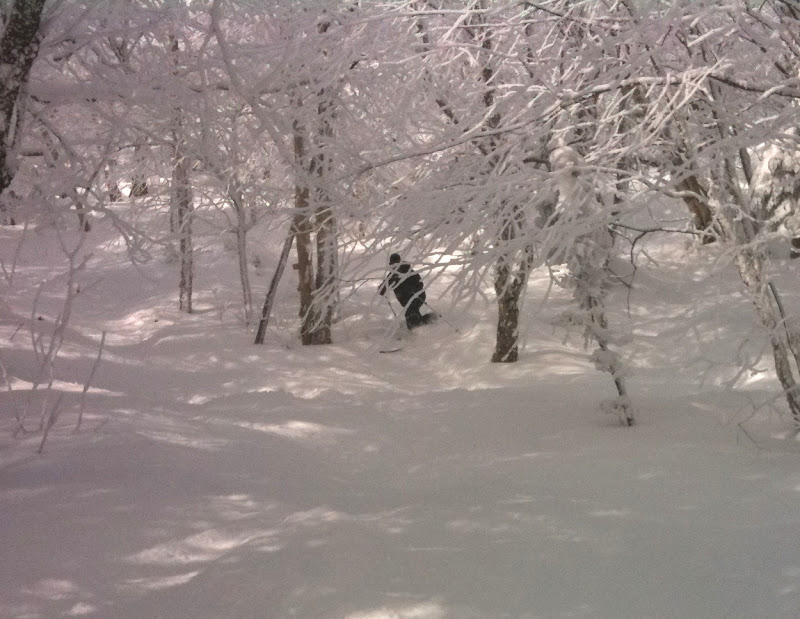
Jay Peak 2/21/10

What creates the "ice fog?" It is a rare but not unknown phenomenon out here. First noted as Mammoth Snowman's explanation for hard snow at the top of Mammoth in November 2008. I suspect there was some before my last visit to Baldy also. Is ice fog generally restricted to high humidity coastal climates, thus nearly nonexistent in the Rockies?
 
Tony Crocker":ua4lni7y said:
What creates the "ice fog?" It is a rare but not unknown phenomenon out here. First noted as Mammoth Snowman's explanation for hard snow at the top of Mammoth in November 2008. I suspect there was some before my last visit to Baldy also. Is ice fog generally restricted to high humidity coastal climates, thus nearly nonexistent in the Rockies?
I think that's it. I encountered this at Stratton about 5 years ago and nearly broke my neck as a result, with the ice fog accumulating on my goggles.

As far as I can tell, it's nothing more strange than a fog layer on the hill when temps are at or just below freezing. With a moist air mass in place but little in the way of dynamics, you'll see this on the coasts and places like interior BC.
 
The ice fog created quite a bit of rime

IMG_1382.jpg


and held up the tram. It was actually quite impressive to see them de-riming the tram on Monday

2tram.jpg


they had to close all the trails that were under the tram line on Monday as well as the Bonnaventure lift until the tram work was done

tramrime.jpg


all my pix were taken with my Iphone...so quality is marginal
 
Tony Crocker":2fd9lj9j said:
What creates the "ice fog?" It is a rare but not unknown phenomenon out here. First noted as Mammoth Snowman's explanation for hard snow at the top of Mammoth in November 2008. I suspect there was some before my last visit to Baldy also. Is ice fog generally restricted to high humidity coastal climates, thus nearly nonexistent in the Rockies?
Actually in the the Salt Lake valley it's not at all uncommon during inversions. Interestingly, what the ill-informed visitors constantly refer to as smog during a strong inversion is predominantly water vapor.
 
Skrad":10ky16kj said:
Not that there isn't a heavy dose of particulates admixed with that water vapor.
Without a doubt. The comment was directed toward the mistaken notion that what you see is 100% smog.
 
Marc_C":3v0iei7r said:
Skrad":3v0iei7r said:
Not that there isn't a heavy dose of particulates admixed with that water vapor.
Without a doubt. The comment was directed toward the mistaken notion that what you see is 100% smog.

Doesn't the definition of smog imply that there's water vapor in it? So wouldn't that brown cloud hanging over the city be 100% smog by definition? I know you SLC guys get all defensive when people talk about the air quality there but smog is smog right?
 
socal":2rhi49je said:
Marc_C":2rhi49je said:
Skrad":2rhi49je said:
Not that there isn't a heavy dose of particulates admixed with that water vapor.
Without a doubt. The comment was directed toward the mistaken notion that what you see is 100% smog.

Doesn't the definition of smog imply that there's water vapor in it? So wouldn't that brown cloud hanging over the city be 100% smog by definition? I know you SLC guys get all defensive when people talk about the air quality there but smog is smog right?
Nope. The term originated in London in the late 1800's when the air was typically chokingly thick with coal smoke.Since there wasn't a term for air pollution, it was called "fog", despite it not being meteorological (ie water vapor) fog at all. Wiki sez:

...the term "smog" is generally attributed to Dr. Henry Antoine Des Voeux in his 1905 paper, "Fog and Smoke," for a meeting of the Public Health Congress. The July 26, 1905 edition of the London newspaper Daily Graphic quoted Des Voeux, "He said it required no science to see that there was something produced in great cities which was not found in the country, and that was smoky fog, or what was known as 'smog.'" The following day the newspaper stated that "Dr. Des Voeux did a public service in coining a new word for the London fog." "Smog" also appears in a January 19, 1893, Los Angeles Times article and is attributed to "a witty English writer."
 
Back
Top