sszycher":2ppl4b56 said:
I'm going to disagree with Qcanoe on at least one thing: the lake-effect snows that N. VT receives. I say lake effect because I don't really think Lake Champlain has that much to do with it, it's usually more becuase of mosture streaming in from the Great Lakes.
Everything I've seen in discussions from the meteorological experts, as well as personal experience, indicates that you guys are correct. Lake Champlain really doesn't contribute very significantly to the traditional lake effect snow seen in the northeast; the east-west fetch just isn't big enough. However, even though Lake Champlain is too narrow to create any significant snowfall during the more typical lake-effect wind trajectories, it does have one thing going for it: it is rather long. The times you will see substantial bona fide lake-effect snow coming off Lake Champlain are when there is a fairly northerly wind (NNW, etc.). This wind direction appears to provide a long enough fetch to pick up moisture for some snowfall, and it seems to hit places like Chittenden/Addison County and maybe have some effect on the Greens near Sugarbush/MRG, but it?s not really a substantial snow producer for the mountains as far as I?ve seen. I think I?ve seen Powderfreak take Lake Champlain snowfall enhancement (Lake-enhanced snow) into account in some of his forecasts, as I know he does for the Great Lakes.
We had at least one nice episode of real Lake Champlain lake-effect snow this season (Tuesday, January 16th), and the band actually sat right over Burlington for quite a while. The band of snowfall was clearly evident on the radar, and it was an obvious lake-effect band because there were no other echoes around. Chris Bouchard from Eye on the Sky commented on it in his VPR report that day, and I believe Powderfreak may have commented on it as well. It was sort of interesting to sit under that band all day while many areas nearby were getting little if any snow, and it provided at least a small flavor of what it must be like for those people in the lake-effect areas of Western New York. My post to SkiVT-L describing the Lake Champlain lake-effect snow from that day can be viewed here:
http://list.uvm.edu/cgi-bin/wa?A2=ind07 ... -L&P=R3141
The real Lake Champlain lake-effect snow happens maybe once or twice a year and it is usually minor, but I can recall the day specifically this year because it was one of the few times when it snowed substantially more in the Burlington area all day than it did at my house in Waterbury.
I?m not sure if many people know that the Great Salt Lake actually contributes snow to the Wasatch as well, and I have seen radar echoes where it is delivering some serious moisture there. I?m not sure what percentage of the Cottonwood Canyon?s snowfall it provides however. It seems that in the Green Mountains, we do profit to some degree from the moisture of the Great Lakes, and even if indirectly, they contribute to the prodigious snowfall we get. However, I hesitate to think of it as too big a contributor because it would be hard to explain why the Adirondacks don?t do better in their annual snowfall (perhaps their annual snowfalls are lower from being too far away from many nor?easters).
One can?t help but wonder what it would be like if the Great Lakes were closer and contributed even more directly to the snowfall in the Green Mountains. Instead of 300-400 inches of snowfall a year, there might be 500-600 inches of snowfall a year. That?s just a rough guess based on what some of the communities directly downwind of the lakes can pick up, but I have no idea what would happen if you stuck Lake Ontario right up against the 4,000-foot wall of the Green Mountains. Someone should model that geography/topography on a computer and see what would happen.
J.Spin


 sugarloaf-18avril 006.jpg14.9 KB · Views: 5,478
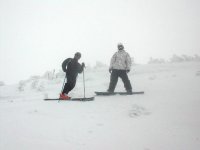 sugarloaf-18avril 008.jpg17.2 KB · Views: 5,475
 sugarloaf-18avril 012.jpg29.3 KB · Views: 5,475
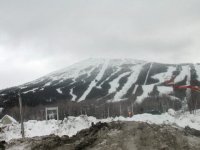 sugarloaf-18avril 014.jpg30.2 KB · Views: 5,481
![11768980394-18-07snow1[1].jpg](/boards/data/attachments/4/4235-19c952fd12ea2113a45cfda7fc8679e3.jpg?hash=GclS_RLqIR) 11768980394-18-07snow1[1].jpg24.6 KB · Views: 5,481
11768980394-18-07snow1[1].jpg24.6 KB · Views: 5,481![11769092094-18-07spillway2[1].jpg](/boards/data/attachments/4/4234-c32a97175a4b6a17bd8545eb38b212bc.jpg?hash=wyqXF1pLah) 11769092094-18-07spillway2[1].jpg26.7 KB · Views: 5,474
11769092094-18-07spillway2[1].jpg26.7 KB · Views: 5,474


 it was resorts in NW Maine (Loaf & Saddleback) who got nailed as the storm slowly drifted E/NE after stalling out over Long Island.