
claurel
Member
I just returned from the Wapta Traverse, a beautiful hut-to-hut ski tour in the Canadian Rockies that lies within the Banff (Alberta) and Yoho (BC) National Parks. This was a guided tour with Sawback Adventures, the same outfit that operated the Svalbard Ski and Sail trip I took April/May 2025.
The Alpine Club of Canada operates a number of huts in the Canadian Rockies that can be reserved for overnight shelter during multi-day ski tours. The Wapta Traverse is a north-south route across the Wapta Ice Field, while the Bow-Yoho Traverse runs east-west. Sawback took care of the logistics (hut reservations, food) and supplied two excellent guides (plus another person doing a guiding practicum, effectively a third guide.) We had nine clients on the trip, all but one of them a fellow skier/snowboard from Seattle.
Our trip ran six days and five nights. It's not necessary to spend this much time on the traverse. If we’d stayed just a single night at each of three hurts, we could have finished very comfortably in four days. However, the extra days give a chance to do some hut based day tours without the need to carry heavy overnight packs. I would definitely recommend taking more time to anyone doing the traverse—the Canadian Rockies are a stunning background, and, well, more skiing is always good! The traverse is mostly over glaciers with gentle grades. The extra days gave us more time to seek out some steeper objectives, though none of the terrain we toured was extreme. Our traverse route started took us across the frozen Bow Lake, up to Bow Hut, then to Balfour Hut, with a final night at Scott Duncan hut. The traverse proper runs about 40 km / 25 miles from Bow Lake to the exit; with the added objectives, I'd guess we traveled around 80 km total.
I had been a little concerned about taking the trip in late April, but winters are long in the Canadian Rockies, and there were no problems with rain or low snow coverage. The first few days, we enjoyed relatively warm and sunny weather, with temps around 0°C / 32°F. The snow was wind-buffed powder up high, spring-like lower down. We hit some areas of breakable crust on day 4 as well as some harder sun and temperature crust. It was no powder paradise, but overall the skiing was quite good.
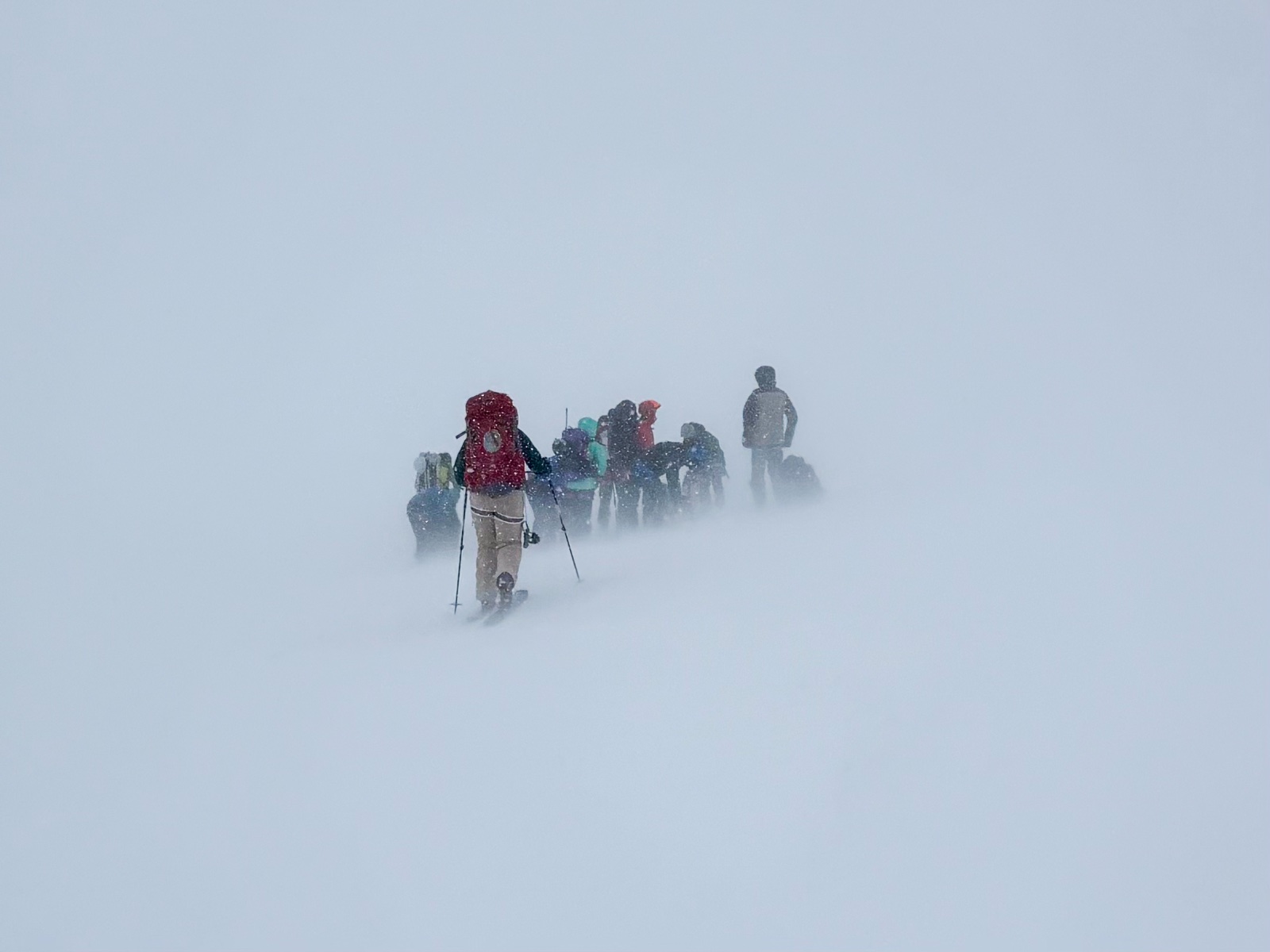
On the afternoon of day 4, the temperatures dropped a *lot*. We woke up to temperatures of -15°C / 5°F and wind, with temperatures dropping further as we ascended to the Balfour High Col to reach the final hut. Several small convective systems swept across the glaciers on day 4 bringing strong winds, around 10 centimeters / 4 inches of fresh snow, and whiteout conditions. One of systems was intense enough that we dug a snow trench for shelter. Fortunately, we only huddled in place for about 15 minutes before the sun returned. I was reminded how lucky we were to have clear weather most of the time—skiing down a glacier in a whiteout would have been no fun at all.
The most challenging part of the trip was the very last two miles. We exited from Sherbrooke Lake via a winding summer trail covered in snow. I was on a splitboard, carrying a heavy multiday pack, winding through the trees, trying to maintain enough speed to make it through the flat sections. Skiers had a better time of it, but no one had fun. Still, it was a small price to pay for an extraordinary ski tour. This was my first hut-to-hut ski tour. I've done lodge, yurt, and sail-based touring before; I expected more of a mountaineering focus than on a typical tour, and that’s exactly what we got.
A few notes:

Touring near Mount Balfour on our way back to the hut for the night
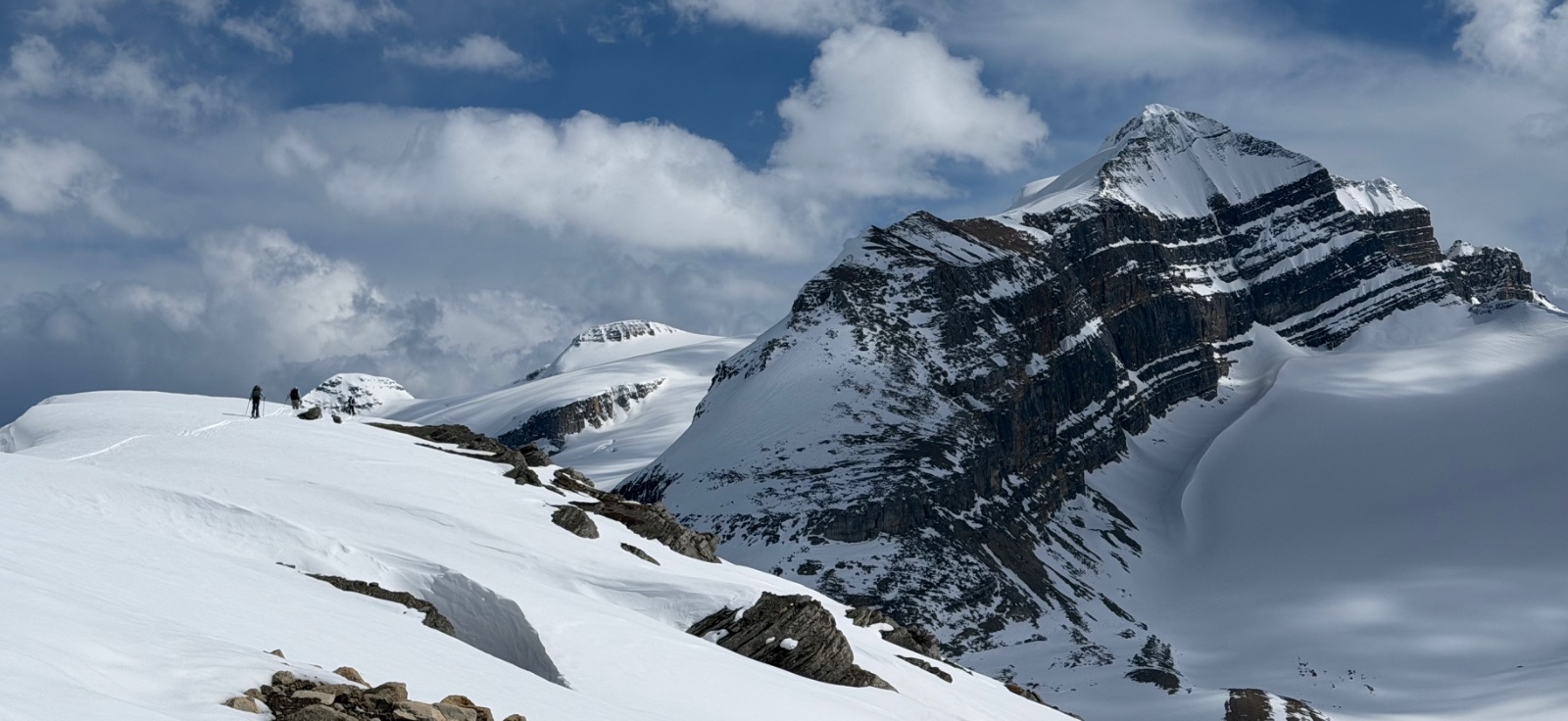
Boot packing to a minor summit (this was the only boot packing during the whole tour.)

Snowstorm on the Balfour High Col. This was where we dug a snow trench to shelter from the wind and wait out the bad visibility.
Balfour Hut. All that snow, so few people to ski it!

—Chris
The Alpine Club of Canada operates a number of huts in the Canadian Rockies that can be reserved for overnight shelter during multi-day ski tours. The Wapta Traverse is a north-south route across the Wapta Ice Field, while the Bow-Yoho Traverse runs east-west. Sawback took care of the logistics (hut reservations, food) and supplied two excellent guides (plus another person doing a guiding practicum, effectively a third guide.) We had nine clients on the trip, all but one of them a fellow skier/snowboard from Seattle.
Our trip ran six days and five nights. It's not necessary to spend this much time on the traverse. If we’d stayed just a single night at each of three hurts, we could have finished very comfortably in four days. However, the extra days give a chance to do some hut based day tours without the need to carry heavy overnight packs. I would definitely recommend taking more time to anyone doing the traverse—the Canadian Rockies are a stunning background, and, well, more skiing is always good! The traverse is mostly over glaciers with gentle grades. The extra days gave us more time to seek out some steeper objectives, though none of the terrain we toured was extreme. Our traverse route started took us across the frozen Bow Lake, up to Bow Hut, then to Balfour Hut, with a final night at Scott Duncan hut. The traverse proper runs about 40 km / 25 miles from Bow Lake to the exit; with the added objectives, I'd guess we traveled around 80 km total.
I had been a little concerned about taking the trip in late April, but winters are long in the Canadian Rockies, and there were no problems with rain or low snow coverage. The first few days, we enjoyed relatively warm and sunny weather, with temps around 0°C / 32°F. The snow was wind-buffed powder up high, spring-like lower down. We hit some areas of breakable crust on day 4 as well as some harder sun and temperature crust. It was no powder paradise, but overall the skiing was quite good.
On the afternoon of day 4, the temperatures dropped a *lot*. We woke up to temperatures of -15°C / 5°F and wind, with temperatures dropping further as we ascended to the Balfour High Col to reach the final hut. Several small convective systems swept across the glaciers on day 4 bringing strong winds, around 10 centimeters / 4 inches of fresh snow, and whiteout conditions. One of systems was intense enough that we dug a snow trench for shelter. Fortunately, we only huddled in place for about 15 minutes before the sun returned. I was reminded how lucky we were to have clear weather most of the time—skiing down a glacier in a whiteout would have been no fun at all.
The most challenging part of the trip was the very last two miles. We exited from Sherbrooke Lake via a winding summer trail covered in snow. I was on a splitboard, carrying a heavy multiday pack, winding through the trees, trying to maintain enough speed to make it through the flat sections. Skiers had a better time of it, but no one had fun. Still, it was a small price to pay for an extraordinary ski tour. This was my first hut-to-hut ski tour. I've done lodge, yurt, and sail-based touring before; I expected more of a mountaineering focus than on a typical tour, and that’s exactly what we got.
A few notes:
- We drove about 10 hours from Seattle to Field, BC to start the trip. It would have been faster to fly to Calgary, but the extra hassle of flying didn’t seem worth it. Our calculation would have been different in mid-winter, where the risk of running into dicey road conditions would have tipped us toward flying.
- The town of Field is only 30 minutes from the Lake Louise Ski Area; we took advantage of that to do a bonus day of resort skiing before beginning the tour.
- One of the skiers on the trip didn’t have a lot of touring experience, but still did well (excepting a few boot fit struggles.) But, I wouldn’t advise a novice split boarder to try it—there are too many flat-ish areas where you need to be comfortable holding speed until the next downhill section. And the final section through trees would be brutal.
- Only the Bow hut was heated (a couple of wood stoves). Nevertheless, we were vastly more comfortable in huts than if we were winter camping.
- There's no cell service on the Wapta Icefield, and we didn't see any other people after we left Bow Hut. I think that's lovely, but bring a deck of cards and something to read.
Touring near Mount Balfour on our way back to the hut for the night
Boot packing to a minor summit (this was the only boot packing during the whole tour.)
Snowstorm on the Balfour High Col. This was where we dug a snow trench to shelter from the wind and wait out the bad visibility.
Balfour Hut. All that snow, so few people to ski it!
—Chris


