Year-round Daylight Savings Time

ChrisC

Well-known member

House GOP resurrects Trump’s plan for year-round daylight saving time

The Sunshine Protection Act would let states stop changing clocks twice a year. A key vote is set to come this week.


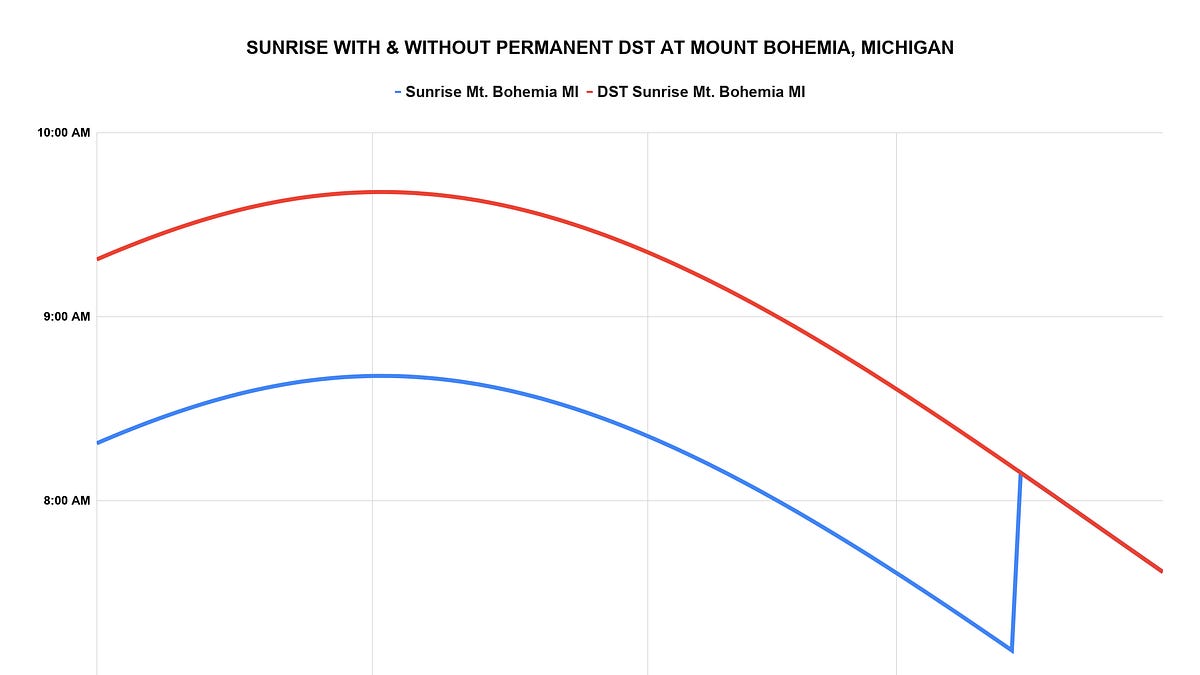
This would cause ski areas to reevaluate their mid-winter operating hours, especially those further north.

Changes were previously mandated by the Energy Policy Act of 2005, which permanently moved the start of Daylight Saving Time to begin on the second Sunday in March instead of the first Sunday in April. It officially began in 2007.


Telluride experimented with pushing back operating hours in March when the change was implemented. This was appropriate since most of the mountain faces West and North. However, skiers could not mentally wrap their head around a ski day that starts at 10 AM. (see Alyeaska's operating hours: 11:00 AM to 6:00 PM)


Last edited:
More interesting: British Columbia

How will Whistler ski? And areas further north like Revelstoke and Kicking Horse?

The Canadian Complication

Before I go any further into the hassles of a potential shift to permanent DST for U.S. ski areas, I’ll point out that most of British Columbia already shifted to permanent DST as of this past March. That pushes sunrise in Whistler - by far the busiest ski area on the continent - past 9 a.m. starting Dec. 10. Sunrise would then peak at a high of 9:12 a.m. from Dec. 30 to Jan. 2, and float back below 9 (8:59 a.m.) on Jan. 23.
 
More interesting: British Columbia

How will Whistler ski? And areas further north like Revelstoke and Kicking Horse?

The Canadian Complication

Before I go any further into the hassles of a potential shift to permanent DST for U.S. ski areas, I’ll point out that most of British Columbia already shifted to permanent DST as of this past March. That pushes sunrise in Whistler - by far the busiest ski area on the continent - past 9 a.m. starting Dec. 10. Sunrise would then peak at a high of 9:12 a.m. from Dec. 30 to Jan. 2, and float back below 9 (8:59 a.m.) on Jan. 23.
Revelstoke has usually opened at 8:30 in January with a 3:30 closure. In early January the gondola loads in the dark, but by the time one reaches the top, the sun has risen. Permanent DST would have sunrise 1 hr later. Perhaps hours will shift to 9:30-4:30
 
The solution seems obvious - adjust your operating hours with the season. Several resorts already do this in spring - Mammoth and Snowbird open an hour earlier to maximize time on ideal snow conditions, while others do the opposite and run later in the day, presumably trading the early bird / breakfast crowd for the for happy hour / dinner.
 
Telluride tried this when Daylight Saving Time was increased to early March in 2007.

Since most of the mountain faces North or West, the ski area assumed people would want time for surfaces to soften.

Skiers/visitors could not handle waiting around until a 10 AM start time. Quickly forgotten.


Last edited:
Mammoth adjusts opening hours earlier starting mid-May or later for intense sun effect, long after normal daylight time has started.

This is a completely different issue from making the starting time later due to light or snow conditions earlier in the season.

Telluride’s policy for March was correct and the public reaction demonstrates exactly why permanent daylight time is a bad idea for ski areas. I agree 100% with Stuart on this. 5 out of 7 years daylight time starts on my first night of Iron Blosam week. With Utah’s longitude the 9am opening is really 7:30am sun time. If it’s warm with no new snow half the hill can be bulletproof past 11am. The High T at Alta can be frozen solid to 3pm and that could apply to the considerable west facing terrain at Telluride. This terrain needs to be open to 5pm in Feb/Mar if on daylight time.

Much of the Alps, especially France, are far west in the Euro time zone. Many lifts run until 4:30 and some until 5pm. The Euros are also more sensible for skiers holding daylight time off until the last week of March.
 
Telluride tried this when Daylight Savings Time was increased into early March.

Skiers/visitors could not handle waiting around until a 10 AM start time. Quickly forgotten.


This move is the opposite of the "we need enough light to operate" complaint, opening at 9 through the winter then pushing hours back in the spring. Northern places complaining about lack of morning light without switching the clocks should just replicate that with their own schedules. No one is going to complain about not being able to ski in the dark.

Plenty of mountains open later than 9 am, though I'm sure most of the businesses in town would oppose later hours so people get off the hill and into the bar earlier.
 
Got it, the real issue isn't the clock change but daylight time itself, and that US skiers are accustomed to getting on the hill at 9 and off by 4 regardless of conditions, unlike the Euros.
 
A somewhat related fun fact is there are no daylight savings times here in Queensland. The rest of Oz has them. We went to a vote in 1992 and voted against them. There is a continued push for them and I'm ok either way but if I had my preference I'd stick with the status quo.
 
Back
Top