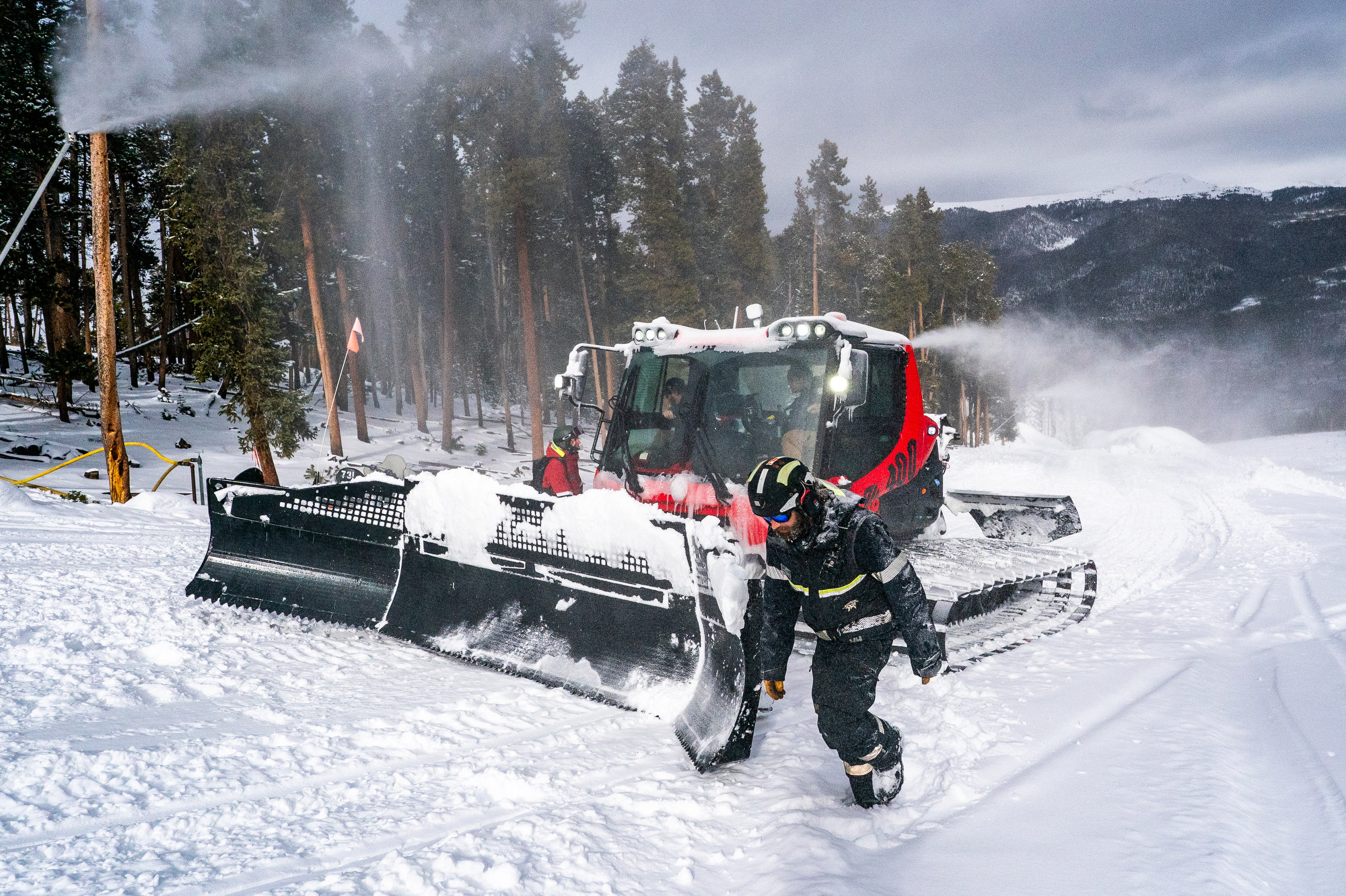
Can Snowmaking Compensate for Climate Change?

But I've been a passholder since January 2005, and they could make snow back then surrounding Alf's. So, sometime prior to 2005. Of course, most summers see a modest improvement somewhere: a new fan gun here, an upgraded water line there.
Thanks for responding. I didn't start skiing Alta regularly until 2008. Before that was a few days in March 1970 and a day in January 1981 or 1982. Always noticed the covered snowguns but didn't gave them much thought during annual April stays at Alta Lodge starting in 2010.

Nevertheless, Alta always closes at roughly the same time every year as business trails off, and employees are off to their summer jobs like river guiding. Alta remains committed to giving its seasonal employees a reliable release date.
Makes sense. I know Alta Ski School has instructors who leave before the final few weeks of the season. Just happens the instructor I work with is from central NC too and he stays until Closing Day before he starts driving away from SLC.

There are no snowmaking reservoirs to work with. Instead, all of the snowmaking water comes from wells, hence its limitation. Water rights in the West are something very expensive to obtain, and guarded ferociously by those who hold them.
The Alta 2023 Master Development Plan included the idea of adding water storage. I have vague memories of the idea of a snowmaking pond that was dropped as the Master Plan was finalized. A storage tank on the Collins side was approved. Extending snowmaking at the top of Supreme was also in the MDP.


Screenshot 2025-11-28 at 2.47.15 PM.png
 
Do you think destination resorts will increase or decrease efforts for early season snowmaking in the near future?
I would expect the gradual increases will continue. I think a lot of recent investment is upgrading to more computerization and especially energy efficiency.

In terms of the initial investments in the West, I know that 1981 on the heels of 1977 was the impetus in Colorado. I would guess that the next surge was during the string of low snow years from 1987-1992. Sun Valley's big push came during this period just like Mammoth's. The next run of lean seasons in many places was 2012-2015. I still wonder when Alta put in snowmaking because there is not a hint of a threatened Christmas there from 1987-88 through 2010-11.

My impression is that snowmaking at destination resorts in big mountains out west is considered important during early season.......Others had owners who didn't think it was worth thinking about seriously because they expected there would always be plenty of natural snowfall.
I think in 1960's and 1970's it was accepted among skiers that in bad years there might be no skiing until after Christmas, and complete wipeout seasons in erratic locations like SoCal. But now skiers expect to ski something at Christmas, so you are not competitive in many markets without snowmaking. Dave McCoy at Mammoth was fine with the occasional wipeout Christmas because his drive-up clientele would still come January - April. But finances have also become more competitive (read corporate) with some debt, so the big companies don't want volatile revenue. Snowmaking is insurance to lessen the pain in the drier seasons.
Mountain Capital Partners places a high priority on snowmaking.
Nearly all of their areas are in the extremely volatile Southwest so snowmaking is correspondingly more important.

As for initial decisions, snowmaking requires big upfront capital investment plus expensive water and electricity operating expense. So if you are say, Alta, Targhee or Mt. Bachelor, do you really want to shell out that upfront investment if you only need it 10% or less of seasons, and even in those only to salvage Christmas? We can already see that even though Alta has installed more pipe that I would have expected, it has not installed high capacity of water and power.

One of the keys for each resort is how important Christmas Is. MCP said it's absolutely crucial at Hesperus, which is why they won't reopen it without snowmaking. If you are Alta, Mammoth or Bachelor with excellent skiing through April, Christmas is proportionately less of your revenue and thus the snowmaking installation decision is a closer call.
 
Did there used to be general articles about snowmaking in Utah, Colorado, or Tahoe? Meaning before 2018 or so.
Absolutely. As a raw beginner I remember reading at the time how awful 1977 was. And I'm sure that Colorado's move to snowmaking after 1981 was newsworthy as well. I didn't get into the snow data business until 1992, so my recollection of that post 1981 snowmaking push had to come from the media.

The mainstream media was all over the horrible start to 2011-12, particularly since the worst places were the only ones they care about, New England and Colorado. Rusty Gregory blamed Mammoth's low skier visits in 2011-12 on bad press even though as in 1981 Mammoth's season was normal after mid-January. He has a point. 2006-07 was not that different but had more skier visits because that slow start was more confined to California and so got less publicity.
 
post 1981 snowmaking push had to come from the media.
Aha! You are correct for Colorado for sure. The number of acres with snowmaking doubled by the start of the 1981-82 season.

According to OnTheSnow, Sun Valley has snowmaking on 645 acres now. Didn't look up any other resort.

October 1981
"
The first snows of the season are due any day now in Colorado's high country. But just in case the weather won't cooperate, anxious Rocky Mountain ski resort operators have bought themselves a bit of snow insurance during the summer.

Badly stung last winter by a poor snowfall that forced some resorts to sharply curtail operations or close altogether, Colorado ski operators have invested more than $20 million this summer to install the pipes, compressors and machines that will allow them to make snow while the sun shines.

Snow-making has been a common practice for many years in Eastern and Middle Western ski resorts, but has come more slowly to ski areas in the Western mountains, which until recent years were usually able to get through the season with natural snowfall.

But when ski season opens here in November, some 2,000 acres of trails and hillsides in Colorado - twice the area covered last year - will be equipped for the artificial snow-making equipment. And more is on the way for the 1983 season.
. . .

As a result, Mrs. Lamm [of Colorado Ski Country U.S.A.] said, resort owners are making heavy investments in what some call ''snow farming'' and others describe as ''snow insurance.''

At Vail, for example, the resort's operators spent $2.6 million during the summer to add 92 acres to the 133 acres already covered by snow-making equipment. By 1983, the resort plans to increase the total coverage to 365 acres.

''Snow-making here is different than it is back East,'' said John Goldman of Vail Associates. ''We don't have to worry about snow at the higher altitudes. The snow-making here is to help cover the areas near the bottom of the mountain.''
. . .
At Snowbird, a Utah ski resort in the mountains outside Salt Lake City, for example, snowfall last winter was more than adequate to sustain full operations through the spring, even though it was 138 inches below the average annual total of 481 inches. ''The decline did make us think about snow-making,'' said Packy Longfellow, a spokesman for the resort, ''but we decided not to make the investment.''

Attendance at the Utah resort was down only 2 percent from the year before, which was the best in the resort's history. At Sun Valley, Idaho, resort operators installed snow-making equipment this summer to cover an additional 55 acres of slopes and trails. In all, 197 of the 1,275 acres of slopes and trails at the resort are now reached by snow-making equipment.

Last winter, attendance at Sun Valley was up 4 percent, at a time most other resorts in the West had poorer attendance."
 
After thinking about when snowmaking first became more widespread in Colorado and Utah, I wondered about Whiteface. I knew snowmaking was important for the 1980 Winter Olympics. That season Whiteface had a very unusual low snow season. Turns out snowmaking was first used at Whiteface in the early 1960s. I was learning to ski in the Adirondacks in 1968-70 on a private hill at North Country School (rope tow) near Lake Placid. Those winters included skiing groomers at Whiteface a few times each season so it was my first big mountain.

December 1961
"
WILMINGTON, N. Y. - In a move that has caused quite a flurry among the old-timers the skiing industry, the Whiteface Mountain ski area in the northern Adirondacks has installed equipment to manufacture its own snow. And in view of the fact that this scenic state-owned winter resort is only a short distance from the Canadian border, the feeling is that the innovation may spread to the more northerly ski centers in years to come. Although officials at Whiteface believe that this popular Adirondack Mountain resort will receive a fair share of natural snow this winter and in other seasons to come, they learned an expensive lesson last year, when little snow fell, and they do not want this to happen again. Last winter, Whiteface, which had enjoyed a boom season in 1959-60, saw its revenues drop 82 per cent below the previous year's level. Only through the efforts of the resort's maintenance men, who carted snow from the woods to the slopes, was Whiteface able to remain open for sixty-two days. Of this total, however, only on a dozen days did good skiing prevail, compared with fifty-three days of good skiing conditions and nine days when conditions were rated “excellent" in the 1959-60 season. In all, the area remained open for 133 days during the winter of 1959-60.

Goal of Officials

In the new snow-making undertaking, area officials have no intention of trying to cover the entire mountain with man-made snow. However, they are prepared to spread a layer of snow from the area's half-way station to the base of the mountain. This area covers about fifteen acres and is accessible to the center's water supply at Danny's Bridge, near the bottom of the mountain. It is estimated that three and one-half miles of pipe will feed water from a steel-reinforced dam built at the bridge to store 40,000 gallons of water, and twenty nozzles will be used to spread the artificial snow over the area.

The use of the snow-making machines eventually may provide the solution to problems encountered by ski areas even farther north than Whiteface. If nothing else, the artificial snow enables an area to keep its beginners' slopes open and its ski school in operation when there is no natural snow at all as on the ground. Had Whiteface had machines available last winter, the income from its ski school would not have suffered as much as it did.
. . ."
 
Back
Top