Since I know virtually nothing about Japan's many ski areas, for the past year or so I've been gathering info from people's past trips here and on the German forums so I'll have initial guidance when I go there at some point in the future (for the moment, it's armchair travelling).
There are not that many 'hidden' areas on Hokkaido island without heavily sacrificing size.
All skiers go to the obvious targets:
- Niseko. Only true-lift served alpine terrain. Large lodging base (Kutchan, Hirafu Village, etc). Skis very much like Mount Bachelor, OR.
- Rusutsu. Liked its trees slightly better than Niseko, but both are good.
- Kiroro. Nice mountain, tighter trees, good sidecountry, but needs help/touring to lap it.
- Sapporo Teine. Smaller, but still steep in places.
- Furano. Inland king, lighter snow.
- Tomamu. Another inland resort.
- Tokachidake and Asahidake. Sidecountry/backcountry areas. Likely need guidance.
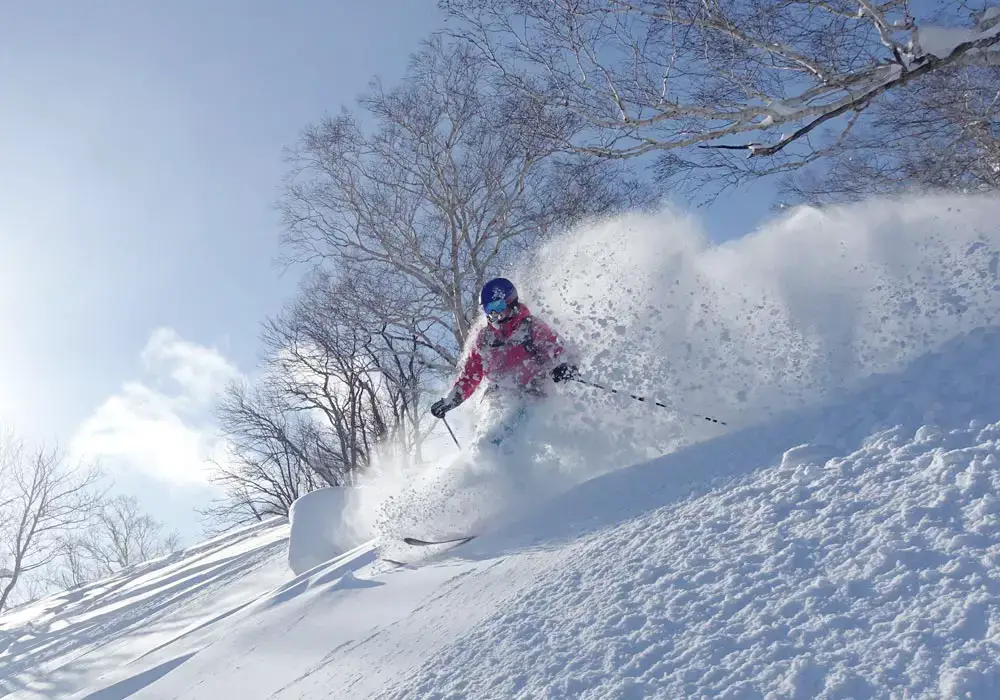
Hokkaido skiing is the ultimate because the north island of Japan is the powder capital. Popular Hokkaido ski resorts include Niseko and Furano. See map of skiing in Hokkaido.

www.powderhounds.com
Again, my critique of Japan is:
- There are not enough trails (or "tracks" in Japan) to provide powder skiing for more than a couple of runs/hours, especially since the trail/ski pods are serviced by relatively high-capacity, high-speed lifts built in the 1980s Boom. Powder trail-skiing is equivalent to the US or Canada; in short, it does not last long. You are quickly going to be skiing cut-up powder by 12noon most places. The only benefit to Japan is the frequent refreshes during mid-winter and high-snowfall months.
- Season: Very, very compressed late December to early March. The Ocean Effect turns off by March, like Upstate NY/Upper Peninsula, etc.
- Elevation/Temperatures: Once the Siberian fronts stop or a warm storm arrives, it can rain. Much more often in Honshu than in the northern island of Hokkaido. (It started raining very depressingly on SBookers ski areas right after he left - lots of IG stories showing rainy Honshu).
- Ja-POW = Tree-skiing is more equivalent to Eastern Hardwoods. The spacing is not great in many areas for linking long stretches of turns. Yes, it's very good for an Instagram Photo of slashing 2ft of powder over your head.
- There is very little open, alpine terrain accessible from chairlifts. Exception: Niseko, which requires single chairs to be open and sometimes hiking to the summit. Despite Niseko being very well-known on the international ski circuit, I still feel like it is the superior ski experience in Japan simply due to the terrain that dominates (360 skiing, alpine terrain on every exposure, lots of trees with sub-alpine spacing, and tighter spacing, some clear/open cut areas (i.e. Alta/Snowbird vs. rest of Utah - or even Brighton/Solitude - terrain is definitely hed and shoulders above the rest!)
- Ja-Pow can mean ski touring! Almost all the legit terrain on Honshu is off-limits to skiers within ski area boundaries, so touring is required. Also, Hokkaido skiable acreage is not huge, so touring and/or lift-assisted touring is commonplace. I have only brought my AT Gear to Japan, not to the Alps.
Overall, I prefer the long, huge, open vertical expanses of the Alps, and its terrain mix of bowls, couloirs, glaciers, and trees. Generally, one can navigate various aspects, sidecountry, and mega-resort scale to find decent snow somewhere.
Would I go back to Japan? Yes! In a heartbeat! I still want to reski/add a few Hokkaido mountains (inland, Asahidake, Furano). The culture, the food, the aesthetic, the vibe, etc.
Honshu is definitely the island where one can find under-the-radar "Little Areas That Rock" (i.e., North America's Alpental, Monarch, Discovery Basin, Mt. Rose, etc.) that are undiscovered by the Western crowd. The resorts under Epic/Ikon: Hakuba, Shiga Kogen, and Myoko, even have some lesser-known areas that SBooker exploited. There are a lot more. (However, go look up the February/March rain that these ski areas received after a great January and half of February.)