You are using an out of date browser. It may not display this or other websites correctly.
You should upgrade or use an alternative browser.
You should upgrade or use an alternative browser.
South America 2026
- Thread starter ChrisC
- Start date

Wrong question. 2009 was the last overall above average season. There are threads here on FTO about most South America seasons since then, and probably a quarter of them had similar starts. The seasons that started strong were usually lean in July and later.Worst start to south american ski season in how long?
Last edited:
Sounds great to me. How far does that extend inland? To the foothills of the Sierra?If you're looking to escape the heat, you could always visit San Francisco; it's generally cooler here than in the Nordic countries.
July in the city can require the heat to be on. Mine is ON this week!
(Note: I have never owned (or rented) in a primary residence with AC - window or otherwise)
Given the summer marine layer and typical weather patterns—where high interior pressure and heat brings in the cold Pacific air—highs are barely above 60°F and lows hover around 50°F. Inside buildings, our temperatures often stay in the low 60s without heating....
Basically, your life is governed by Fog Trackers:
Fog Today
Is it sunny at the beach? Check the latest fog conditions in the Bay Area with Fog Today.fog.today
Link
View attachment 52311
Sometimes, you want to head inland to Walnut Creek or Mount Diablo for a hike, or venture north to Napa, St. Helena, Sonoma, or Santa Rosa—or even down to Silicon Valley—if you’re looking for 80–90°F summer temperatures.
Meanwhile, South Florida is all about tracking PM thunderstorms.


ChrisC
Well-known member
Sounds great to me. How far does that extend inland?
Ha, it doesn't. That marine layer is limited to a few square miles of microclimate specific to San Francisco and the immediate coast.
The rest of the Bay Area has entirely different patterns, and you really can't grasp the complexity until you’ve spent time here. You can find massive variations in weather within just a half-mile radius, heavily influenced by hills, mountains, and proximity to the water.
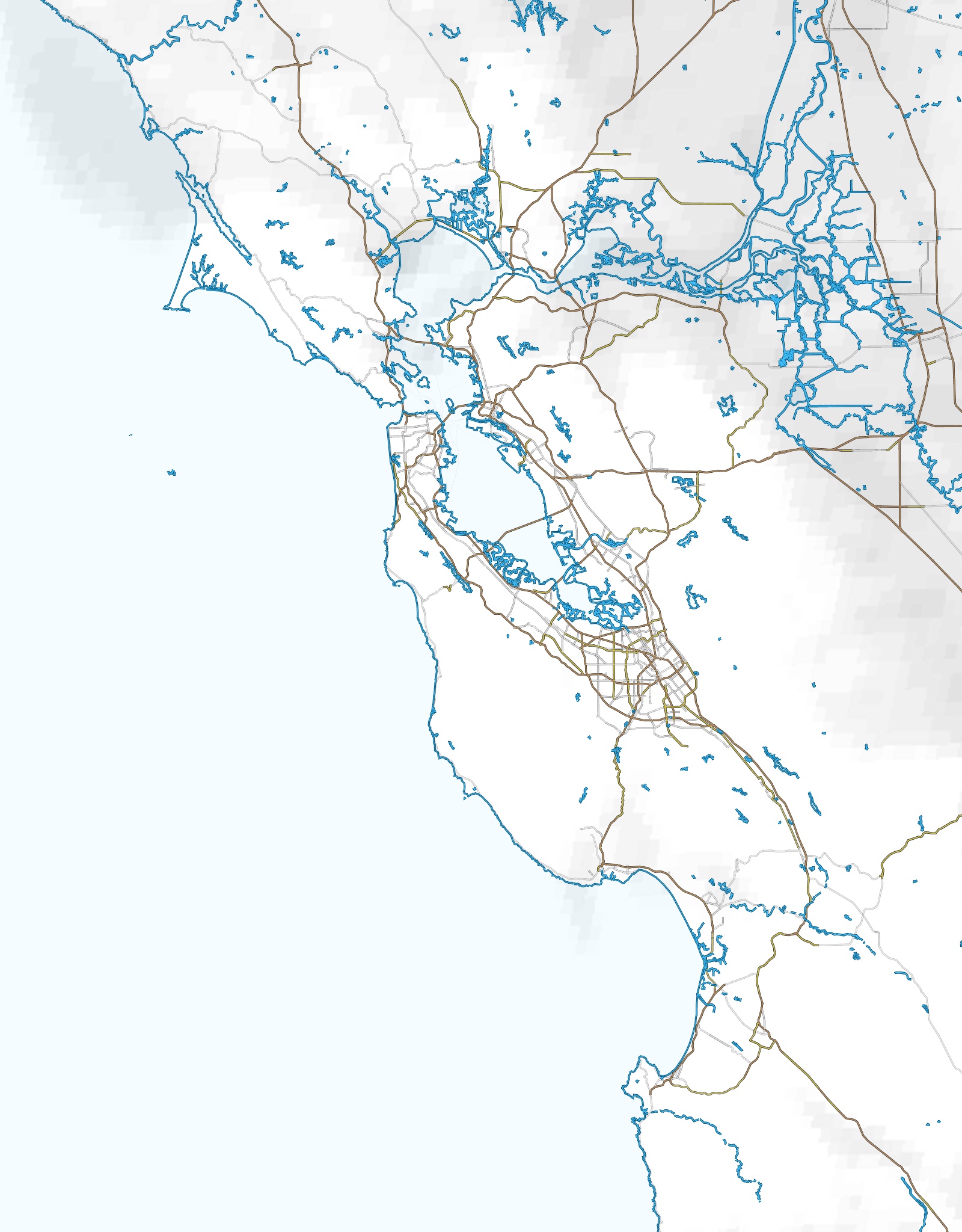
To give you an idea of the extremes, there’s often a 50°F temperature differential between downtown San Francisco and suburban Walnut Creek (Mt Diablo hike)—a distance of only 20 miles with almost no change in elevation.
In the city, there are neighborhoods (Sunset, Richmond) where you might not see the sun for weeks in the summer (red X). However, neighborhoods (Noe Valley, Potrero Hill, Bernal Heights, etc) on the lee side of peaks like Twin Peaks, Sutro, and Davidson are semi-protected, often seeing two to four times as much sun while remaining an easy commute to Silicon Valley or SFO (green square).
Ironically, in the Bay Area, waterfront real estate isn't the most desirable—people usually prefer the hills. The coastline/SF Bay is often plagued by fog, the cold Pacific, brackish water, and wetlands, and much of the waterfront in SF is built on landfill, which is a major seismic concern.
To the foothills of the Sierra?
The foothills of the Sierra are mostly suburban sprawl for 40 miles from Sacramento to Auburn (I-80) or Placerville (50). To me, the foothills, while geographically well-located and forested, are not all that desirable. They are exurbs with great hiking and parks, but probably cost $100s in gas plus traffic to go anywhere: job, forest, shopping, etc.
This is the real reason why the drive to Tahoe almost always sucks. Sure, weather can impact the climbs/passes (as expected), but every single day of the week one needs to deal with the Sacramento Metro rush hour. Also, Tahoe's roads cannot really handle Saturday or major holiday traffic.
Yes, vacationers will say, "I visited for a week in February, and everything was great - no lines or crowds!" Yes, this is always true. Tahoe = Vermont crowd flows. No one is there midweek. And Reno Airport is a breeze. Go!
LA to Mammoth is likely an easier commute because one never hits traffic/gridlock once outside of LA, crosses 7,000-ft passes, or has minimum chain control.
SF Bay Area (9M people) is mostly forced to drive through Sacramento metro (2.5M). Imagine if one had to commute to Colorado front-range resorts: Denver (3.8M) and then drive through SLC (1.3M) to get to a crowded Breckenridge? That's Tahoe (Palisades, Northstar, Heavenly)
Note: Look at Tseeb's departure/arrival schedule for Tahoe. 3-5 AM is a common wake-up and/or departure time. And it's realistic/necessity. Alternatively, one can leave at 8/9 PM on Fridays to arrive at 12/1 AM to avoid traffic.
Last edited:

tseeb
Well-known member
I cutoff most of reply from @ChrisC which I agree with although we are getting very off-topic for this thread. I live in a very warm part of San Jose, 50 miles S of SF but with 2K-almost 4K' elevation Santa Cruz mountains blocking cool air from ocean.SF Bay Area (9M people) - forced to drive through Sacramento metro (2.5M). Imagine if one had to commute to Colorado front-range resorts: Denver (3.8M) and then drive through SLC (1.3M) to get to a crowded Breckenridge? That's Tahoe!
Note: Look at Tseeb's departure/arrival schedule for Tahoe. 3-4 AM is a common wake-up and/or departure time. And it's realistic/necessity. Otherwise, one can leave at 8/9 PM on Fridays to arrive at 12/1 AM.
Weather.com San Jose monthly averages temps (last column is rainfall in inches and temps are taken ~10 miles closer to SF Bay than my house):
| Historical Monthly Avg | |||
|---|---|---|---|
| July | 82° | 59° | 0.01 |
| August | 83° | 60° | 0.03 |
| September | 81° | 58° | 0.07 |
30 miles south of San Jose, where official temp yesterday was 77 and 81 was predicted for today, Gilroy recorded 99 yesterday according to the local paper and 90 according to weather.com. Morgan Hill in between San Jose and Gilroy can get even warmer but both it and Gilroy usually benefit from cooling afternoon breezes that don't get into some parts of San Jose (or Los Gatos). And they can often get fog from Monterey Bay.
We have only run air conditioning a couple of times this year, for ~20 min before 4 PM when our power rates jump if we are going to be home and upstairs is approaching 80F. Then we move downstairs where it stays cool. We usually benefit from overnight cooling that starts before sunset and has included lows of 48 the last two Friday and 47 this AM.
I try to ski Kirkwood on my way to (and often from) Tahoe, even though I'm retired and don't usually share the road with Weekend Warriors. To get there for 9 AM opening means leaving home at 5-530. Going from San Jose to Kirkwood has the advantage, besides being only 175 miles (half non-freeway), that you are going against commute traffic and when passing through Stockton there is almost no traffic vs. Sacramento where there is traffic approaching and going through the city beginning not much after 6 AM. But a couple of miles before Kirkwood is the Carson Spur which often closes during and after storms as it's "one of the most active avalanche zones above a highway in North America". And https://dot.ca.gov/caltrans-near-me...avalanche-control-rehabilitation-project-sr88 includes "The Carson Pass & Spur produce more volume of snow on the highway than any other roadway in the bottom 48 states". Carson Pass, between Kirkwood and South Lake Tahoe, almost 8600' elevation and is the highest pass Caltrans tries to keep open in Winter. Closes less than the Spur.
Last edited:
I’m also a sucker for encouraging forecasts (like this one from Corralco), and I missed skiing last summer waiting for more snow in the Andes before buying a ticket. This year I’ve booked a returnable mileage award Aug 24-Oct 6, likely I will go just to ski whatever man made groomed slopes are available at La Parva and Valle Nevado. Hope to ski with some of this group, or meetup apres. 2024 was great, likely the best season in 15 years?
Go now, you never know how many ski days you have left in your life. (Warren Miller rephrased?)
Go now, you never know how many ski days you have left in your life. (Warren Miller rephrased?)
Attachments

Last edited:

Patrick
Well-known member
This!!! I know there are many more ski years in my past than in my future.Go now, you never know how many ski days you have left in your life. (Warren Miller rephrased?)
If you wait for the ideal situation, you might be missing out, sometimes you have to take a risk and just go.
Snow data is very sketchy. In our South America threads I will erratically post Portillo season-to-date numbers. When I was at Portillo in 2007 Iooked up Henry Purcell and he provided me with 1970-2007 data averaging 254 inches. Here are the last dates in seasons I have looked up Portillo snowfall since 2011.
Portillo never opened during 2021, mostly due to COVID but I recall comments that the season was very bad like 2019. So we can say the 2023 and 2024 were similar to the prior average and it's possible that 2016 El Nino was close to average as well. But no clear cut above average seasons since 2009. The above applies to Valle Nevado and Las Lenas as well, but not necessarily to Chillan and Corralco with far different climatology.
In the years where the date above is in September, that was usually because the ski areas were about to close. Unlike North America or the Alps, significant storms after the spring equinox are rare. The "Santa Rosa" period in late August/early September is viewed as usually the last shot at a significant dump. The big exception was 2023 with big storms in the first half of September, which ChrisC chased on short notice.
We have been paying attention to South America here on FTO at least since my first trip with Extremely Canadian in 2005. But it's been mostly erratic and anecdotal. Only last week did I go through those threads to collect whenever I had posted Portillo season-to-date snowfall.
| Portillo | as of | |
| snow | date | |
| 2011 | 190 | Sep.8 |
| 2012 | 128 | Sep. 5 |
| 2013 | 208 | Sep. 8 |
| 2014 | 190 | Sep. 26 |
| 2019 | 48 | Aug. 8 |
| 2020 | 224 | Sep. 21 |
| 2022 | 163 | Sep. 11 |
| 2023 | 256 | Oct. 1 |
| 2024 | 261 | Oct. 19 |
| 2025 | 171 | Sep. 20 |
Portillo never opened during 2021, mostly due to COVID but I recall comments that the season was very bad like 2019. So we can say the 2023 and 2024 were similar to the prior average and it's possible that 2016 El Nino was close to average as well. But no clear cut above average seasons since 2009. The above applies to Valle Nevado and Las Lenas as well, but not necessarily to Chillan and Corralco with far different climatology.
In the years where the date above is in September, that was usually because the ski areas were about to close. Unlike North America or the Alps, significant storms after the spring equinox are rare. The "Santa Rosa" period in late August/early September is viewed as usually the last shot at a significant dump. The big exception was 2023 with big storms in the first half of September, which ChrisC chased on short notice.
We have been paying attention to South America here on FTO at least since my first trip with Extremely Canadian in 2005. But it's been mostly erratic and anecdotal. Only last week did I go through those threads to collect whenever I had posted Portillo season-to-date snowfall.
After my 2004 divorce I skied in the Southern Hemisphere the next three seasons.Go now, you never know how many ski days you have left in your life. (Warren Miller rephrased?)
??? That's a long trip, so plenty of time to chase where the best snow is, even if as far as Chillan/Corralco. Do not even think about booking lodging until immediately before arrival. If we had not committed to Valle Nevado lodging in 2007, we could have gone to Chillan where Patrick had just skied fresh snow.Aug 24-Oct 6, likely I will go just to ski whatever man made groomed slopes are available at La Parva and Valle Nevado.
Do not expect much if any lift service past mid-September. But if you are a backcountry skier, late September could be good for the volcanoes like Pucon.
If you wait for the ideal situation, you might be missing out
 says the person who has put off ANY skiing in the premier regions of the Northern Hemisphere January-March for 18 years!
Patrick
Well-known member
Not going to touch this again, my employers 1995 to 2016 didn’t really allow me to take time off in certain time of the year. Tony might recall that my 2006 Montana to Utah trip almost didn’t happen as they was talk to have it canceled due to « operational requirements » up until my departure (Election on Jan 23).
I asked for one week off in February, this was asked 5 months earlier and again numerous times to having management refuse my request. I was even blame afterwards on pre-approved 1-2 days off during the season. And I’m not going to mentioned the pain and fight I had my leave approved when my mom died which lasted 9 months.
The above mentioned incidents were at least a decade ago and the January-March pattern continues with no end in sight.
Last edited:
Patrick
Well-known member
My current job and commitment for my athletes would not be fair to say « sorry, I’ll be absent » for 1-2 weeks. I don’t think Tommy Lasorda would have left the Dodgers during the season?The above mentioned incidents were at least a decade ago and the January-March pattern continues with no end in sight.

If I take less responsibilities, maybe?
My job has great financial and non-financial skiing advantages (salary, passes, deals on passes and equipment).
Sorry, there's no way I'm not swinging at a softball like:
If you wait for the ideal situation, you might be missing out