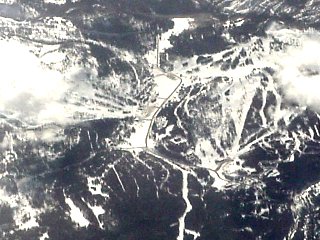
Brian Head, UT – The silence was deafening.
Standing atop the rim of Cedar Breaks National Monument’s crimson
cliffs, the enveloping stillness was punctuated only by a lone crow soaring
somewhere thousands of feet below in the nearly limitless void. Far beyond,
the Escalante Desert of southern Utah stretched to the horizon. The red, yellow
and purple walls, spires, columns and arches of the three-mile-wide limestone
amphitheater were adorned with the peaceful white of unblemished snow. Bristlecone
pines clung to the windswept ridges above the rim. I stood in complete awe,
drinking in the intoxicating view for a full twenty minutes.
Mere yards away, however, Brian Head Resort was a marked departure
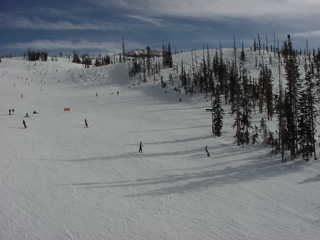
from the chasm beneath my feet. There, cheerful skiers and snowboarders swooped
down the undulating alpine staircase, carving wide giant slalom turns on broad
corduroy boulevards, or bumping energetically down moderately-pitched mogul
fields. The summit of Brian Head Peak stood watch over all, its sentinel rock
face brooding.
Yes, skiing in southern Utah was a study in contrasts.
n
AN EDUCATION IN CLIMATOLOGY
|
Cedar Breaks National Monument
Forbidding cliffs line Route 143, the access road to
The slopes of Brian Head Peak
Brian Head’s stunning views include the red rock formations
The steep chutes of Brian Head Peak lie above the resort’s
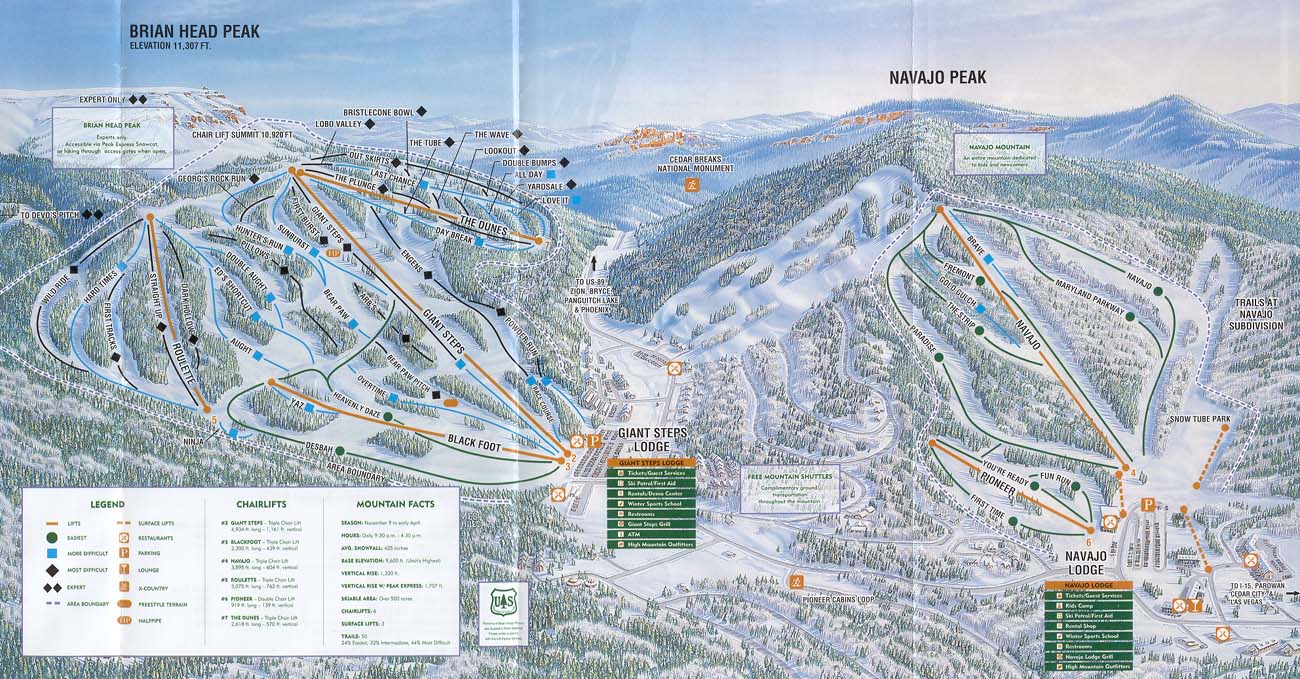
(Click on the trail map to open a full-size map in
Backcountry opportunities abound on Brian Head Peak’s
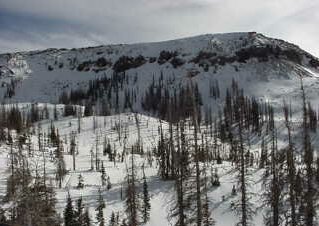
Few of Brian Head’s trees have survived the spruce
Wide-open cruisers are Brian Head’s calling card |


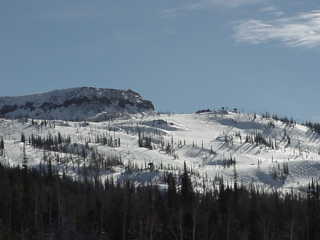



Brian Head, equidistant between Salt Lake City and Las Vegas,
is the closest big-mountain ski and snowboard experience to the gambling capital
of America. Three and a half hours of direct driving along Interstate 15 separate
the roulette wheels from the bullwheels.
Ninety minutes from the resort, however, the landscape begins
to change dramatically. Leaving the final gambling oasis of Mesquite, Nevada
and its desert environment complete with decorative palm trees, the highway
rises dramatically as it heads northeast through the claustrophobic walls
of the Virgin River Gorge to arrive at St. George, Utah, the winter home of
the LDS Church’s founders. Exiting the highway at the sleepy hamlet of Parowan,
the two-lane road to Brian Head ascends precipitously through a full five
climate zones, rising from the high desert and joshua trees of southern Utah
past steep, forbidding cliffs to arrive at an unexpected winter wonderland
at Brian Head.
Accordingly, the views from the slopes of the resort are nothing
short of stunning. The interstate stretches north to the horizon across the
high desert toward Salt Lake. Closer in, the red rock formations within Dixie
National Forest, named for the memories of the Deep South that the region’s
warm climate inspired in Brigham Young’s followers, lend credence to the region’s
nickname, “Color Country.” To the southwest, glimpses of Cedar Breaks
lead one’s gaze toward the Escalante Desert. Off to the southeast, the ledges
of the Grand Staircase-Escalante National Monument descend across 1.7 million
rugged and remote acres toward the sun, where they culminate in the Grand
Canyon. The region has changed little since the Anasazi, Fremonts, Southern
Paiutes and Navajo were its only inhabitants.
Altitude, not attitude, is everything in southern Utah. Thanks
to its lofty perch – at 9,600 feet, Brian Head’s base is the highest in the
state – Brian Head enjoys a surprising 425 inches of average annual snowfall,
and the dry desert air ensures that what falls is light and fluffy, and stays
that way. Although the early season had not been kind to Brian Head prior
to my arrival, the lack of recent snowfall only meant that surfaces were dry
and chalky rather than fresh. The snow ages well here, despite the intense
rays of sun at this latitude.
TWO BASES, ONE RESORT
Brian Head’s slopes and lifts rise along either side of Route
143 on two separate mountains: Brian Head Peak, and Navajo Peak. Heading up
from Parowan, one first arrives at the base of Navajo, Brian Head’s hill devoted
to novices and low intermediates that coexists with the resort’s hotel lodging
in the welcoming Cedar Breaks Lodge and The Lodge at Brian Head. Continue
further up Route 143, though, and the steeper slopes of Giant Steps rise on
the left above a significant collection of condominiums and private residences
and below Brian Head Peak.
At the moment, one cannot ski from one to the other. Although
the Georg’s lift once ascended Navajo Peak from the road directly adjacent
to Giant Steps, this lift has since been removed and this sector is now inhabited
by snowmobiles and toboggans. The resort’s plans call for a new lift at Georg’s
traversing the road and once again connecting the resort as one, but one holdout
landowner whose property the lift will traverse has prevented this vision
from becoming a reality. For now, skiing or riding both Navajo Peak and Giant
Steps requires a short, free shuttle bus ride between the two.
I checked into my condo in the Briarwood development before
heading out for a first afternoon of skiing. Advertisements taped to the window
informed that the unit was for sale, as appeared to be the case with many
units here, and although cozy and comfortable the new owners would surely
upgrade the antiquated carpet and furnishings to more current standards. At
the price of the unit, however, one could easily afford to accomplish the
renovation. Full ownership of the condominium was listed at a fraction of
the price of mere timeshares at other, better-known resorts. A typical one-bedroom
condo here will set you back a mere $40,000.
A GRAND STAIRCASE OF THEIR OWN
It is not without good reason that the primary lift at Brian
Head, a fixed grip triple chair, is named Giant Steps. The terrain here descends
1,161 vertical feet in a succession of pitches and flats, cascading and tumbling
to the base. Accordingly, the terrain here is interesting, and skis far bigger
than the mountain’s modest statistics would suggest.
The spruce beetle, bane to many western American ski and snowboard
resorts, has positively decimated the forest at Brian Head. Although this
detracts from the physical beauty of the slopes, it has opened up much of
the between-trail terrain at Brian Head, allowing one to craft a nearly infinite
combination of lines by skiing a drop here, traversing to another drop over
there, etc. Brian Head Marketing Director Craig McCarthy takes this “glass
half-full” view of the pest’s destruction.
If there is a criticism to be made regarding Brian Head’s lift-served
terrain, it’s that there is little present to entertain the expert. Runs such
as Straight Up, Wild Ride and First Tracks (What a great name for a trail!
– Ed.) in the Roulette chair’s separate enclave are bumped but lack any
nosebleed steeps. “This is a 95% mountain,” said McCarthy. “95%
of the skiing and snowboarding public is a beginning or intermediate skier
or snowboarder. This mountain is great for them. If you’re an expert, you’ll
probably want to spend a day or two here and then go somewhere else. 95% of
the people will love this place, and quite frankly, we’re proud of it.
“If you look at our regional markets,” McCarthy continued,
“they’re Las Vegas, Arizona and southern California. They’re desert markets.
There aren’t a lot of experts typically in desert markets. Those people want
to come up and have a good time, they want to cruise … they aren’t the type
that normally goes and jumps off cliffs.”
From mid-season on, however, the steep scree fields of Brian Head Peak
above the resort’s lifts are accessible via a short boot-pack or snowcat ride
($5 per trip) and easily make up for this deficiency, increasing the vertical
drop on this side of the resort to a respectable 1,548 feet. Other popular
backcountry routes descend the backside of Brian Head Peak to a point where
a spotted car could easily return powder enthusiasts to the lift network.
Parties with experts amongst them could also easily mix things up with a visit
to nearby Elk Meadows Ski & Summer Resort east of the city of Beaver, where some steeper terrain is offered.
Brian Head excels at giving those 95% of glisse enthusiasts
exactly what they’re looking for: acre upon acre of wide-open groomed corduroy.
It’s the staple of family skiing, and Brian Head is very family-friendly.
Novices and young skiers may enjoy the gentle slopes of Navajo Peak outside
the door of their hotel room without the slightest concern that anyone will
encounter terrain beyond their ability, or be intimidated by experts speeding
past. No one will end up separated from another at the mountain’s singular
base. After dinner, turns may still be had under the lights below Navajo’s
Pioneer chair, or families may speed down snow tubes in the adjacent Snow
Tube Park.
Likewise, everyone at Giant Steps will end up at the same base
area, and the vast majority of the terrain there is moderate. Kids will blast
across the tabletops, rails and halfpipe of Giant Steps’ terrain park while
parents relax in the warm southern sun on the ample deck at the lodge. The
resort staff is uniformly friendly, welcoming and helpful.
FRIENDLY LOCALS, TOO
At the end of the day, I sat down to a tasty ribeye at the Double
Black Diamond Steak House in the Cedar Breaks Lodge with Brian Head Resort’s
Kara Kowalski and local skiers Bob Hillis and Al Smith.
Hillis has been at Brian Head seemingly forever, since his parents
first discovered Brian Head in 1972 as a place to get away from it all from
the back of a ski magazine. The following week they arrived, bought a condo,
and never left. His straggly mane of long blonde hair elicited the stereotypical
ski bum image. As the wine flowed, so too did the conversation.
“Brian Head is still stuck in the ’70s,” Hillis began.
“It’s a back home, country resort where you can come and, just like at
home, meet somebody at the bar, ski with them the next day and just have a
great time.”
“It’s a family hill,” Smith added, stating what had
by now become the obvious. “There are no lines here like there are in
southern California, at Mammoth or Big Bear with their 45-minute lines.”
“If there’s a 5-minute line here, you’d be saying ‘it’s
crowded today, man!'” Hillis interrupted.
Accordingly, Californians looking for a quieter, less expensive,
more family-friendly atmosphere and an easier drive constitute roughly one
third of Brian Head’s business. Another good chunk comes from Vegas, where
the resort focuses much of its marketing effort with a package called Ski
Las Vegas that combines poker and powder. “It’s either us or Mammoth,”
Hillis said of the Vegas and southern California markets.
“We’ve already maxed out southern Utah,” Kowalski
added, “as pretty much anybody who skis comes here already.” Most
of the Brian Head’s season passholders come from the snowbirds who populate
St. George’s moderate climate, or university students from Cedar City.
Having concluded dinner, we moved over to the Pinnacle Breaks
Club to continue our conversation over a couple of beers and a friendly game
of pool. It’s a good thing that the bar was nearly empty, because I couldn’t
make a shot to save my life. I’d like to blame the altitude, but it must’ve
been the wine.
Between pathetic attempts to sink a solid, I learned that Brian
Head was founded in 1964 with a rope tow at Georg’s, and has been owned solely
by Jim Trees, a Houstonian, for the past seven years. While Trees seldom visits
the resort, he has had the foresight to hire a management staff much more
familiar with ski area operations. “The people he has working here are
very, very good skiers,” Kowalski explained.
The resort’s master plan, drawn up years ago, is stunning in
its breadth. It includes a possible surface lift ascending Brian Head Peak’s
steeps, and other lifts extending much further to the north. It will require a dramatic
increase in skier visits, however, before such grandiose plans come to fruition.
Despite proposals to expand Cedar City’s airport for regularly-scheduled
airline traffic, such expansion is not likely to occur anytime soon, given
Brian Head’s relatively remote location. The resort sees Las Vegas, which
has tripled in size in the past 20 years, as its answer.
Whether or not the elements of the master plan are ever realized,
Brian Head will nonetheless continue to offer a down-home family ski and snowboard
experience to those willing to make the trip.
|
IF YOU GO …The Roof: Numerous independent Thirty-five miles away The Eats: Dining The Fun: Go snow Brian Head is a family |