
Telluride, CO – The unique experience that is Telluride starts before the airplane wheels touch down. At 9,078 feet, Telluride Regional Airport is the highest commercial airport in the continental United States. Usually, flights reliably end with a descent into the destination airport. Not this one. No descent, no ears popping, just a gentle, level glide onto a tiny airstrip sitting on top of a mesa above this southwestern Colorado ski resort town.
Telluride itself is a unique ski town. It’s not an ersatz town that was created just for tourists, but actually has a rich history from before skiers arrived. Founded in 1878 as a mining town extracting gold and silver from the surrounding San Juan Mountains, even the origin of the town’s name itself is controversial. It may be named after “tellurium”, a mineral found near gold and silver deposits, or it may come from a conjunction of “To Hell You Ride”, emphasizing its remoteness. Either way, it’s a cool name. While Telluride boomed and was extraordinarily wealthy (reportedly, around 1900 it boasted more millionaires than New York City), the town faded when the precious metals ran out in the early 1950s. Telluride over next 20 years has been described as a bit of a ghost town.
|
The gondola connecting Telluride and and Mountain Village rises directly from town. |
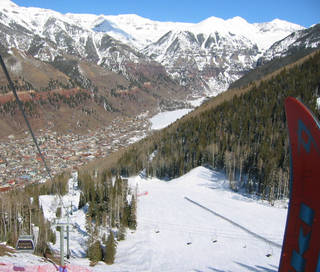
All that changed in 1972 when the ski area opened. Two lifts erupt upwards right out of the town. One of them, the Free Gondola, is another unique Telluride feature. Free to all when the mountain isn’t open, and free to those without skis when it is, the gondola is used as public transportation between the Town of Telluride and the Town of Mountain Village, where Telluride created a more stereotypical ski resort base area with typical amenities, dining and lodging. Many folks can be seen commuting from town to town in street clothes, freely mixing with the skiers and snowboarders.
Lift 8, at just over 1,000 vertical feet, departs right from town next to the Gondola station. It crests the first face of the mountain and gives access to a couple of double-black rated trails, Mine Shaft and Cat’s Paw. Yet another unique experience of Telluride is skiing down Cat’s Paw as you drop back into town. Not everything off Lift 8 is so steep; there are plenty of intermediate routes, too, including one descriptively named “Bail Out”.
|
Terrain off Telluride’s Chair 8 sports steep, tight lines. |
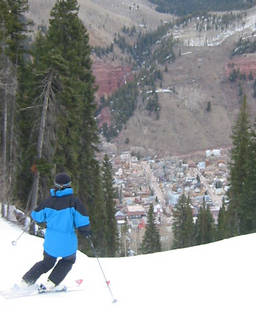
Lift 8 has a cool Telluride tradition. On powder days, the hounds rise early and place their skis in line to hold their place while they meander back through town to eat breakfast or what not. How civilized compared to the frenzied jockeying for position at most places!
Chair 9’s base is at the top of Chair 8. This lift, gaining 2,125 vertical feet, accesses some of Telluride’s most famous terrain. The runs off Chair 9 are all rated black or double black, except for one blue named “See Forever”. Chair 9’s trails hug the falline and plunge straight down the hill.
In fact, a famous Telluride trail off Chair 9, accessed from See Forever, is The Plunge, which was featured in a frequently aired credit card commercial from a few years back. A black to double black trail that drains straight down the falline, it lives up to its name. Other trails include Kant-Mak-M (no doubt referring to turns here) and East Drain, a very narrow trail that can consist of a single line of bumps running straight down the center, leaving little margin for error.
Perfectly situated at the top of Chair 9 is Guiseppe’s Restaurant (elevation 11,890 feet), serving great sandwiches and snacks. After fueling up here, a choice of delights await. In addition to all the terrain served by Chair 9, you can access the Apex area from here and ski a bunch of trees between the trails named Sully’s, Apex and Allan’s Alley. The number 6 chair will bring you 1,145 vertical feet back to the Apex, just up from Guisepe’s at 11,975 feet elevation.
|
Telluride’s Gold Hill |
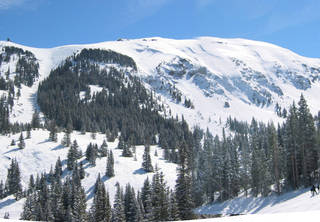
A newly developed area of Telluride is the Prospect Bowl area. It opened in January 2002 and sports two detachable quads. One, “Gold Hill” (lift 14), rises 1,475 vertical feet in a speedy four minutes. Elevation at the top of Gold Hill is 12,255 and it feels like it. The views, understandably, are spectacular. Gold Hill accesses a wide, long and steep face that provides ample challenge from about five named routes, including a steep bowl called “Little Rose”.
The other lift in Prospect Bowl is named (duh!) Prospect Bowl (Lift 12), rising 1,050 feet in five minutes. At the top of the Prospect Bowl lift sits High Camp at 11,815 elevation. This little hut serves excellent sandwiches and coffee. High Camp is also the access point to a little sidecountry hill named “Bald Mountain”, accessed by skiing right when you get off Lift 12. For only about a 10 to 20 minute hike, Bald Mountain rewards the intrepid trekker with a couple of named routes (“Audrey” and “Jackpot”), which can offer untracked and steep freshies after everything else is tracked out. While there is ample intermediate terrain serviced by Lift 12 (e.g., “Sandia” and “Magnolia”), a little more hiking to the left when you disembark the lift offers short and sweet bowl skiing. There are even some sweet trees off this lift, including a spot called “Turbo Roll” that reminded me of nothing more than Eastern skiing in tight trees at Mad River Glen or Jay Peak.
New for the 2007-08 winter, Telluride will open Black Iron Bowl, adding eight runs of backcountry-style terrain adjacent to Prospect Bowl. The area sits against the dramatic backdrop of Palmyra Peak on the western end of the resort.
“Black Iron Bowl is both challenging and exceptionally beautiful,” said Jeff Proteau, vice president of operations for the ski resort. “We are excited to offer our guests an unforgettable backcountry experience within the ski area boundary.”
|
San Juan powder |
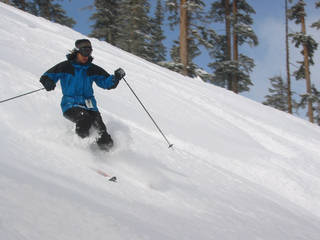
Black Iron Bowl, named for an old mining claim, is accessible via Lift 12 (Prospect Lift) and a short hike out Prospect Ridge. Skiers and riders will be able to drop in anywhere from 10 minutes to 30 minutes hiking time along the ridge. Dropping 1,000 vertical feet on the primary pitches, terrain includes the expansive Mountain Quail couloir, open glades and steep chutes. The Mountain Quail couloir had previously been accessible as guide-only, but now the full expanse of Black Iron will be open for public access as conditions allow. Other new runs include Westlake, Lakeview, Review, Dihedral Chute, Dihedral Face, Jello’s Bowl and Nice Chute.
On-mountain dining is capped by Allred’s at the St. Sophia gondola station at 10,550 feet elevation. While it is members-only for lunch, we were lucky to get to sample its fine cuisine. Allred’s offers a happy hour open to all, as well as world class evening dining, which you enjoy while looking down at a spectauclar view of the town.
|
Western quaint chic at the New Sheridan. |
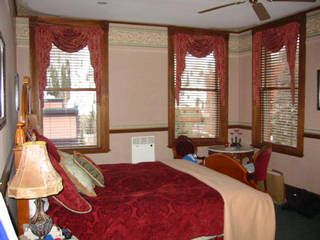
Telluride does not lack for yummy dining options down in town, either. Our favorite was the Cosmopolitan, located in the Hotel Columbia. Just steps from the Gondola and Lift 8, the Hotel Columbia is a boutique hotel offering interesting rooms for the discriminating traveler. The New Sheridan Hotel is another fine lodging choice in town, boasting over 100 years of accomodating guests in Telluride. The room was very comfortable, furnished in a way that evoked the old West. If you stay at the New Sheridan, don’t miss the roof top hot tubs. Relaxing up there, watching the the alpenglow as the sun set over Telluride Mountain, is a truly special and romantic way to end each day in this truly special and unique Colorado ski town.
For More Information: www.tellurideskiresort.com